
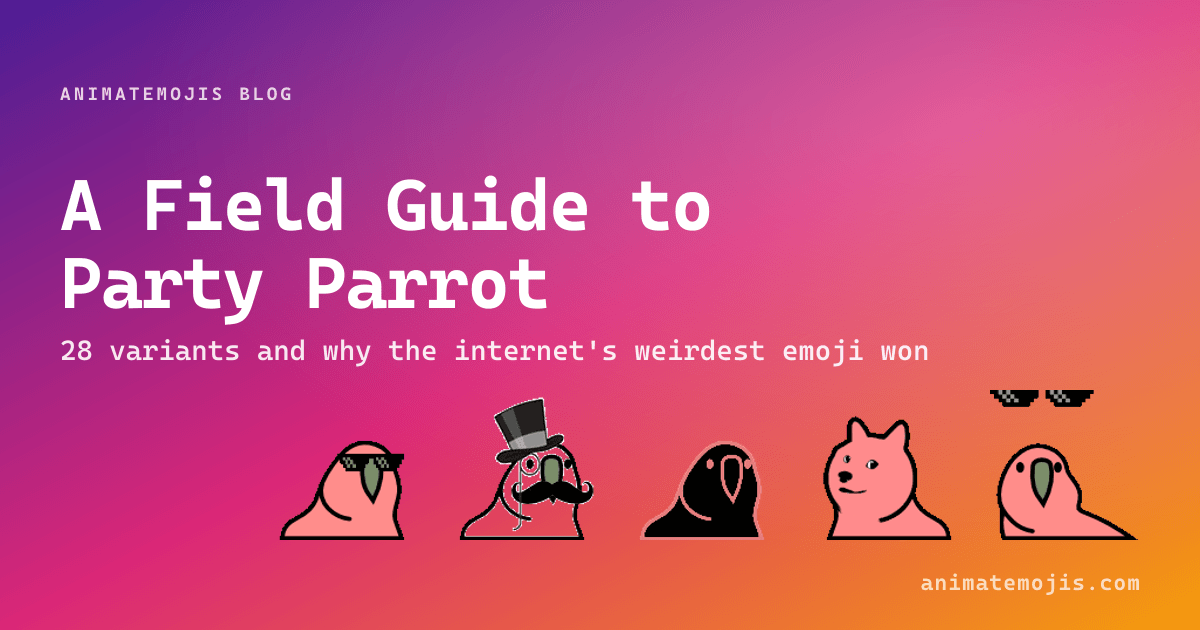
A Field Guide to Party Parrot: 28 Variants and Why the Internet's Weirdest Emoji Won
Riley Nakamura
April 17, 2026 · 7 min read
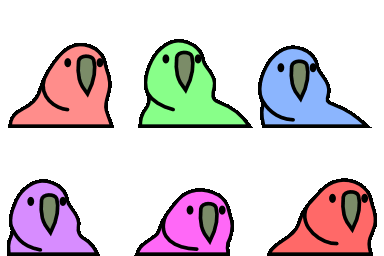
Somewhere on a Slack server right now, someone is reacting to a closed ticket with 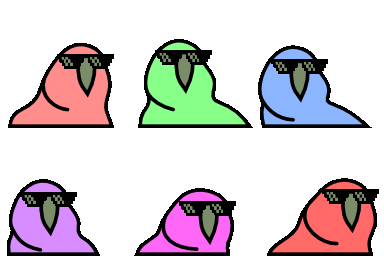 . They're the fifth person to do that in that channel today. A decade ago this bird did not exist. Today there are at least 28 variants of it loose on the internet — some fast, some slow, some in top hats — and none of them have anything to do with actual parrots.
I've spent more time than I'd like to admit watching this emoji operate in the wild. Here's what I've found.
 The short version
Party Parrot is the most successful custom emoji in internet history. It won because it loops perfectly, renders legibly at thumbnail size, and says nothing — so teams can graft their own meaning onto it.
The Original
The story starts with a copy-paste. In the late 2000s, a graphic designer named Jan van den Berg drew a set of rotating parrot frames for a personal project. In 2016, developer Sindre Sorhus took those frames, stitched them into a looping GIF, and uploaded it to a Slack workspace as :partyparrot:. He put up a one-page website — cultofthepartyparrot.com — and walked away.
Nobody planned the rest. Slack teams started copying the emoji between workspaces. Then GitHub, then Discord. Within a year it had reached a critical mass where you could assume any new chat tool either already had party parrot or would within a week of opening to public beta.
The Cambrian Explosion
Once the original existed, people couldn't stop remixing it. The variants started appearing on that same Cult of the Party Parrot site. A slower version for ironic use. A faster one for bigger energy. One wearing a top hat. One doing the Nyan Cat trail.
By 2017 there was an unofficial set of rules for what qualified as a "real" party parrot: 10 frames, 256×256, transparent background, infinite loop, no start or end. Anything that broke those conventions was considered derivative.
This mattered more than it should have, because party parrot had accidentally become a visual protocol. Any emoji built to the same spec slotted cleanly into Slack's grid without breaking the rhythm of a reaction row. The format became the message.
A Taxonomy of Parrots
I group the 28 variants I could find into five families. They roughly correspond to how people actually use them.
 The Speed Class
Distinguished only by tempo. The most useful family, because a conversation can modulate emotional intensity just by picking the right BPM.
- Slow Parrot — for sarcastic "wow, very nice."
- Stable Parrot — the baseline. Neither fast nor slow.
- Party Parrot — the original, somewhere around 140 BPM.
- 60 FPS Parrot — same tempo, smoother interpolation. Uncanny in a good way.
- Fast Parrot — genuine excitement.
- Ultra Fast Parrot — catastrophic excitement, or sarcasm about catastrophe.
 The Mood Class
Variants with emotional content beyond "party."
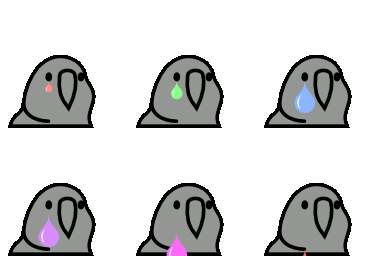
- Sad Parrot — the drooping posture is genuinely affecting. Reserve for postmortems.
- Sassy Parrot — sassy.
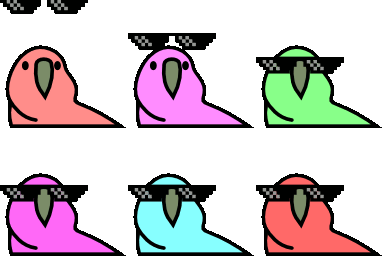
- Deal With It Parrot — the sunglasses descend.
- Troll Parrot — the trollface mask, for when trolling must be made explicit.
- Witness Protection Parrot — blurred face, for redacting.
- Dark Mode Parrot — inverted palette. Pairs well with the 2 AM Slack message.
 The Costume Class
Party parrots in outfits.
- Gentleman Parrot — top hat and monocle. The most overused Victorian-England joke on the internet, and still funny every time.
- Mask Parrot — a regular venetian mask. Good for ambiguous undercover ops.
 The Crossover Class
Party parrot fused with other memes.
- Doge Parrot — Shiba Inu in parrot form. Such dance. Very bird.
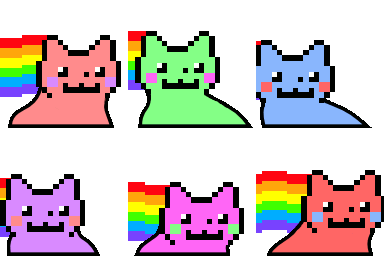
- Nyan Parrot — the nyan trail behind a parrot head.
- Minecraft Parrot — the in-game Minecraft parrot, which actually is a real parrot, doing the dance. This is the only variant where the source material canonically parties.
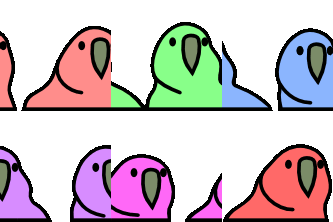 The Geometry Class
Variations in direction, rotation, or grouping.
- Reverse Parrot — opposite rotation.
- Inverse Parrot — mirrored horizontally.
- Conga Parrot — three parrots in a conga line.
- Parrot Reverse Conga — the conga, backwards.
- Shuffle Parrot — side-to-side shuffle instead of spin.
- Bouncing Parrot — up and down instead of rotating.
- Rythmical Parrot — keeps a metronomic beat.
- Parrot Portal / Orange / Blue — entering and exiting Portal portals. Canonically the most Valve-coded emoji.
 Count note
The canonical Cult of the Party Parrot site listed 100+ at its peak, but many are regional or workspace-specific. The 28 in this guide are the ones with durable cross-platform distribution — the ones you're likely to actually encounter in 2026.
 Why Party Parrot Won
Three reasons, in descending order of importance.
It loops perfectly. Ten frames, no start, no end. Your brain cannot get bored because there is no narrative arc to notice. It's the GIF equivalent of a fidget spinner. Once you start looking, you can't stop, but you also don't feel compelled to do anything about it. Perfect background noise.
The file size is tiny. The original is around 70 KB. It uploads to any custom-emoji system without hitting limits. More importantly, it's legible at 24×24. Most animated emojis are gorgeous at 512×512 and indistinguishable mush at thumbnail size. Party parrot is one of the few that still reads as a party parrot when Slack squeezes it into a reaction bar.
It says nothing. This is the underrated feature. Because the parrot has no clear emotional meaning, teams graft their own meaning onto it. On one engineering Slack I watched for a year, :partyparrot: meant "ship shipped." On a design team next door, it meant "approved." On a writing community Discord, it meant "this post goes hard." Same bird, three dialects. A more semantically specific emoji — a fire, a heart, a thumbs up — gets pigeonholed. Party parrot resists pigeonholing.
 How to Use It Well
Rules I've picked up from watching this bird in the wild.
- One parrot per message. Stacking five of them doesn't multiply the joy, it cheapens it. Party parrot works because it's slightly overdone, not because it's the only thing on the page.
- Match the speed to the stakes. Using Ultra Fast Parrot in response to a typo correction is funnier than it has any right to be.
- Don't mix families. A Gentleman Parrot in response to a Sad Parrot reads as mocking. The costume class wants distance from the mood class.
- Age matters. In teams older than three years, party parrot is nostalgia. In teams less than six months old, it's identity-building. Either is fine — just know which one you're doing.
- Never party parrot your own news. Let someone else add it. Parroting yourself is the emoji equivalent of laughing at your own joke.
 One last thing
Party parrot won't be the forever champion. Eventually some newer, stranger emoji will take the throne — probably something with even less semantic content, even smaller file size, and even more remixability. Until then, there's the bird.
Featured: Download Your Favorite Parrots
Free in WebP, GIF, and Lottie JSON. No account, no payment. Click any parrot to grab it.
Party Parrot
Fast Parrot
Ultra Fast

Slow Parrot
Gentleman

Dark Mode
Deal With It
Sad Parrot

Sassy
Conga
Doge
Nyan
Browse all 1,100+ animated emojis →
Sources & Further Reading
- Cult of the Party Parrot — the canonical index of officially-recognized variants, maintained since 2016.
- Sindre Sorhus — the developer who uploaded the first
:partyparrot:to Slack and kicked the whole thing off. - jmhobbs/cult-of-the-party-parrot — the GitHub source for the official index, useful for anyone trying to contribute a new variant.
- Slackmojis — Parrot Emojis — the largest public catalog of parrot variants, including community submissions beyond the canonical set.
- Emoji.gg — Parrot search — Discord-focused directory, useful for the newer variants that never made it onto Slack.
- The Verge — "The strange origin story of party parrot" — decent mainstream coverage of the early viral spread.
- Minecraft Wiki — Parrot — for context on the in-game parrot's dance animation, which Minecraft Parrot is based on.